
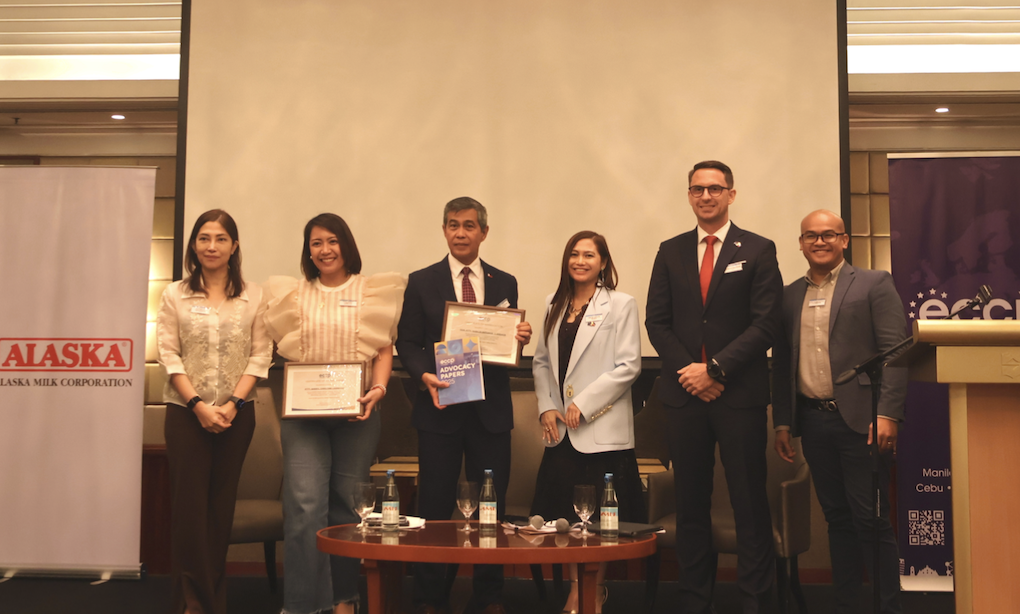
The Philippine dairy industry remains heavily dependent on imports, but its low local production base also points to a major growth opportunity for farmers, processors, investors, and food industry players, National Dairy Authority (NDA) Administrator and CEO Atty. Marcus T. Andaya told stakeholders at a recent European Chamber of Commerce of the Philippines (ECCP) dialogue.
Speaking before dairy and food industry representatives during the ECCP luncheon meeting at Makati Shangri-La on May 19, Andaya said the Philippines has produced only around 1 percent of its total dairy requirements locally over the past 30 years, leaving the country dependent on imports for 99 percent of its dairy supply.
Despite this, Andaya said local milk production has started to improve, reaching 43 million liters in 2025, equivalent to a 2.2-percent milk sufficiency rate. This was a significant increase from 27 million liters in 2023.
“These numbers tell us two things: First, our domestic dairy industry remains underdeveloped. Second, the room for growth is enormous. The challenge is significant, but so is the opportunity,” said Andaya.
Quoting Agriculture Secretary Francisco Tiu Laurel Jr., Andaya said that “the dairy industry in the Philippines is a sunrise industry.”
The briefing, convened by the ECCP, brought together regulators, dairy companies, food manufacturers, and other industry stakeholders to discuss the implementation of Republic Act No. 12308, or the Animal Industry Development and Competitiveness Act.
The law is expected to reshape the dairy sector by expanding the role of the NDA beyond development work and into regulation, food safety certification, product registration, monitoring, and enforcement.
For industry players, the discussion placed the country’s dairy import dependence in a broader business context: while the current supply gap exposes the Philippines to external shocks, it also creates space for domestic production, farm mechanization, processing, food safety investments, and stronger market linkages.
Andaya said RA 12308 gives the NDA a stronger mandate to support the industry’s growth while ensuring that regulatory systems keep pace with food safety and market requirements.
“For the NDA, RA 12308 expands and strengthens our role not only as a developmental agency, but also as a regulatory and food safety certifying institution for the local dairy industry chain,” Andaya said.
He also cited funding support under the law and related programs, including an authorized capital of ₱1 billion for the NDA; ₱1.5 billion annually for the next 10 years from the Animal Competitiveness and Enhancement Fund; ₱500 million for food safety and regulatory functions; and ₱840 million through the Philippine Center for Postharvest Development and Mechanization for dairy farm mechanization, among others.
ECCP Food & Beverage Chairperson Helen Grace Baisa, in her opening remarks, described the current period as “a pivotal period in the Philippine dairy industry,” noting the importance of dialogue between regulators and businesses as the sector undergoes transition.
“The ECCP remains committed to supporting policies and regulatory frameworks that promote transparency, predictability, food safety, regulation, and ease of doing business — all of which are essential in fostering a stable and competitive environment for the food and labor sectors,” she added.
The ECCP said it was the first foreign chamber to hold a briefing on RA 12308 and the transition of dairy regulatory oversight from the Food and Drug Administration to the NDA.
The event was attended by ECCP leaders, including Executive Director Florian Gottein and Board Member and Alaska Milk Corporation Managing Director Tarang Gupta. Nestlé Philippines supported the event, with Alaska Milk Corporation and Mr. Moo’s Dairy Products Inc. as table top partners.

Serving the European-Philippine business community since 1978, the ECCP remains committed to enabling cross-sector collaboration, promoting economic growth, and championing a sustainable future. For inquiries or further information, you may contact us directly or connect with us through our official social media channels.