
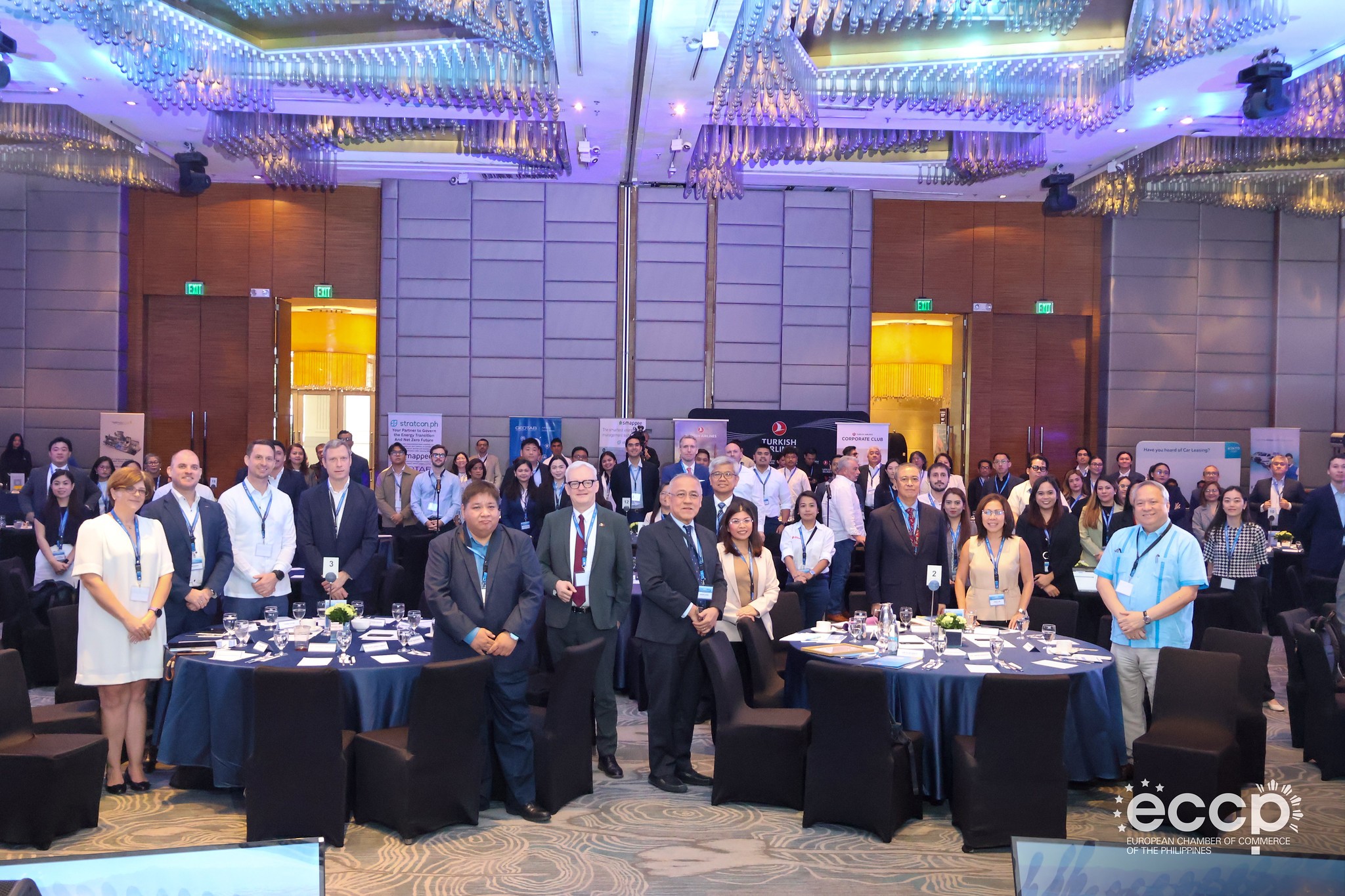
MAKATI CITY, Philippines — The future of safer, smarter, and more sustainable mobility took centre stage at the ASEAN Transportation Forum 2026, held Thursday, October 8, 2026 at the Marriott Hotel Manila. Co-organized by the European Chamber of Commerce of the Philippines’ Automotive and Aviation Committees with the Asian Business Aviation Association (AsBAA), the forum brought together government leaders, industry experts, and mobility stakeholders to examine key developments shaping air and land transportation in the Philippines and across Southeast Asia.
The event coincides with the Philippines’ ASEAN Chairmanship, themed “From Roads to Runways: Advancing Safety and Sustainability in Air and Land Transportation,” with discussions addressing the region’s growing connectivity demands, road safety, Sustainable Aviation Fuel (SAF), and electric vehicle (EV) adoption.
“As we look ahead to ‘Navigating our future, together,’ addressing the Philippines' transport and energy challenges becomes an urgent priority,” said Dr. Diana Edralin, President of ECCP. “The decisions we make today will shape the mobility, connectivity, and environmental landscape of ASEAN for decades to come,” she added.
In his opening message of support, Dr. Marco Gemmer, Head of Partnerships of the Delegation of the European Union to the Philippines, reiterated the importance of a business-public sector investment nexus: “Only the private sector’s investment will make our public investment sustainable,” he said.
DOTr Reaffirms Commitment to Integrated, Multi-Modal Transport System
Delivering the keynote address on behalf of Department of Transportation (DOTr) Secretary Giovanni Z. Lopez, DOTr Undersecretary Teodorico Delfin outlined the administration's strategic vision to transform mobility and connectivity across the Philippines through fully integrated, multi-modal transport networks.
Undersecretary Delfin emphasized President Ferdinand R. Marcos Jr.’s directive to build a system where railways, roads, airports, and seaports seamlessly connect to move people and goods efficiently.
Highlighting signature infrastructure developments, the undersecretary provided updates on major railway lines, including the JICA-supported Metro Manila Subway, connecting key economic hubs directly to NAIA Terminal 3, and the 147-kilometer North-South Commuter Railway (NSCR), featuring the nation's first airport express link to Clark International Airport.
To streamline freight logistics, he detailed the proposed 212-kilometer Subic-Clark-Manila-Batangas Railway under the Luzon Economic Corridor, which handles over 80 percent of the country’s port traffic.
On urban transit and active transport, DOTr underscored ongoing upgrades to the MRT-3, expansion of the 24/7 EDSA Busway, rolling out of the Cebu BRT and DavaoBus modern fleet networks, and first-mile/last-mile cycling and pedestrian infrastructure.
Addressing air transport and Public-Private Partnerships (PPPs), he showcased completed regional airport expansions and major private sector modernization partnerships, including New NAIA InfraCorp's expansion of NAIA’s annual capacity to 62 million passengers and regional PPP deals for Laguindingan and Bohol-Panglao airports.
“Through Public-Private Partnerships, we can bring private-sector investment and expertise into airport modernization, helping us expand capacity and improve services faster. But we also look at how these investments connect with the wider transport network, so that our airports work together with road, rail, and public transport,” said Undersecretary Delfin. “The government cannot do this alone. We need the private sector and our international partners,” he adds.
Modernizing Aviation Infrastructure for Regional Connectivity
The forum opened with discussions on aviation infrastructure, air safety, and regional connectivity. Lt. Gen. Raul L. Del Rosario AFP (Ret.), Director General of the Civil Aviation Authority of the Philippines (CAAP), shared perspectives on strengthening the country’s aviation infrastructure and enhancing connectivity as the region’s air transport demand continues to grow.
“Passenger traffic is expected to grow at a compound annual rate of 7.2%, placing us among the top growth markets in the 25 to 100 million passenger category,” said Director General Del Rosario.
In a panel discussion moderated by Mr. Samuel David, Country Manager of the International Air Transport Association (IATA), the aviation chief and the Chief Legal Officer of the Civil Aeronautics Board, Atty. Wyrlou E. Samodio, further examined the role of modern aviation infrastructure and coordinated efforts in building safer and more connected skies. “ASEAN plays a very important role in the gamut of air transport,” said Atty. Samodio.
The Green Horizon and and Sustainable Aviation Fuel
The forum then turned to aviation’s energy transition, examining the investment landscape and private sector readiness for sustainable aviation fuel (SAF).
Ms. Morinaella Jeusine M. Torgo, Supervising Investments Specialist of the Board of Investments, discussed opportunities for investment in SAF, while Ms. Helene Burger, Head of Sustainability Asia-Pacific at Airbus, shared perspectives on private sector preparedness and green fleet procurement.
“The Philippines has resources, policy direction, an investment framework, and partnerships needed to participate meaningfully in the growing SAF market,” said BOI’s Ms. Torgo.
For the business perspective, Airbus’ Ms. Burger notes: “We want to make sure that SAF is economically viable: both for the producer, [and also for] the airlines that are going to buy it.” She adds, “The most sustainable fuel is the fuel you do not burn,” emphasizing efficiency gains through fleet modernization.
Ultimately, the discussion underscored that achieving net-zero aviation requires bridging the gap between the energy and transport sectors. As the Philippines works toward more sustainable mobility and resilient regional supply chains, continuous technological innovation, from near-term efficiency gains to breakthrough next-gen platforms, remains essential to fueling this transition.
Bridging Gaps and Saving Lives: Building Safer Roads through Collaboration
The afternoon sessions shifted focus to road safety, with discussions on strengthening preventive measures, infrastructure, enforcement, and cross-sector action.
Hon. Mark Steven Pastor, Undersecretary for Road Transport and Infrastructure of the Department of Transportation (DOTr), presented the Department’s road safety initiatives, highlighting the role of government action in reducing road-related risks and improving transport safety.
“Despite the gaps and challenges in the implementation of the PRSAP, the Department continues to take concrete and significant strides towards reaching our goal of a Philippine society with zero deaths on the road. We continue to strengthen our strategies as the lead agency for road safety through a whole-of-government approach, ensuring a strong, reliable, and proactive road safety management in the country,” said Undersecretary Pastor.
The session also featured a video message from Mr. Jean Henri Todt, United Nations Special Envoy for Road Safety, reinforcing the importance of sustained global and national efforts to advance road safety: “Until everyone arrives safely everyday, there is still urgent work to do,” the envoy noted.
Smarter Mobilities and Transport Modernization
As cities face increasing mobility demands, the forum also examined how digitalisation, integrated planning, and stronger coordination can support more efficient transport systems.
Hon. David Angelo R. Vargas, Assistant General Manager for Operations of the Metro Manila Development Authority (MMDA), discussed Manila’s role in the ASEAN Smart Cities Network and the opportunities for smarter, better-connected urban mobility.
“Smart mobility is not only about technology or transport infrastructure. It also requires digital systems, integrated urban planning, and coordinated governance. For the MMDA, our role is to help connect these efforts across the 17 LGUs and with national agencies, the private sector, academe and development partners. This is how we see Metro Manila contributing to the ASEAN Smart Cities Network through smarter mobility, stronger coordination, and a more integrated and livable metropolis,” said AGM Vargas.
The succeeding panel discussion also brought together perspectives from government and industry, including Colin Steley, Managing Director of Stratcon.ph, and Sofia Guinto, Country Manager of InDrive, with discussions moderated by Atty. Kathyrin Pioquinto, ECCP Director for Advocacy & Government Affairs.
On addressing urban fragmentation, InDrive’s Country Manager Guinto underscored the role of shared mobility platforms in building a cohesive transport ecosystem. “All modes of transportation are not competing with each other, they are complementing each other,” Guinto noted, calling for stronger cross-sector partnerships. “We should have a lot more government collaboration.”
Building on the challenges facing Metro Manila’s urban layout, Stratcon.ph’s Managing Director Steley underscored gridlock and legacy infrastructure delays as immediate hurdles. “Technology is a potential primary challenge, [but] the biggest challenge in [Metro Manila] is congestion,” Steley noted, highlighting how immediate digital interventions can bridge physical gaps. “There's so much value in the telematics of being able to bypass those long infrastructure timelines.”
In response, the MMDA’s Supervising Environmental Management Specialist Monica Mateo notes: “We need to be sure that if we are going to adopt a new technology, we are aligned with what we have. [..] For smart mobility to happen, we really need partnerships. All sectors need to work together.”
The Green Transition: Navigating the Path to Sustainable and Efficient Transport
The final session focused on the transition towards electric mobility and the development of a stronger EV ecosystem in the Philippines.
Hon. Elvin Garcia, Acting Chief of the Heavy Industries Division, Manufacturing Industries Service of the Board of Investments, discussed investment incentives supporting EV adoption, while Mr. Edmund Araga, President of the Asian Federation of Electric Vehicles Association, shared perspectives on accelerating the region’s electric mobility transition.
“EVs can form part of the cleaner and more efficient air system, particularly when supported by appropriate infrastructure. [Its] development can also bring opportunities for fielding suppliers, and workers, to participate in emerging chains.” said BOI Chief Garcia.
“EV growth requires not only vehicles, infrastructure and policies but also a qualified workforce. Technical skills development is therefore an important part of building the EV ecosystem,” said AFEVA’s Araga.
Moderated by Arch. Ahn Meg Adonis, Sustainable Transport Lead of Clean Air Asia, the discussion underscored the importance of coordinated policies, investment, and industry participation in advancing cleaner and more energy-efficient transport.
While manufacturing growth in the Philippines has lagged behind its ASEAN neighbors, a strong emphasis on talent development is shifting the momentum. “The skillset is very important: we have to develop it, and focus on it,” notes Araga. Aligning with this drive, BOI’s Garcia highlights the government's strategic response: “[..] Under this regime, we are at parity in terms of incentives, with other countries.”
Advancing the Future of Mobility
Across the sessions, the forum highlighted a common priority: transportation must evolve alongside the Philippines’ growing connectivity, economic, and environmental needs.
From modernising aviation infrastructure and strengthening road safety to accelerating smart mobility and the green transition, speakers underscored the value of sustained collaboration across government and the private sector.
Through the ASEAN Transportation Forum 2026, the ECCP continues to provide a platform for constructive dialogue on policies, investments, and innovations that can contribute to a safer, more connected, and sustainable transportation future for the Philippines and the wider ASEAN region.
The ASEAN Transportation Forum 2026 was co-organized by the European Chamber of Commerce of the Philippines Automotive and Aviation Committees, and the Asian Business Aviation Association, and was supported by Advocacy Partners: Embassy of Finland in Manila, Embassy of the Federal Republic of Germany Manila, Embassy of Romania in the Republic of the Philippines, Embassy of Ukraine in the Republic of the Philippines, Business Sweden; Industry Partner: Island Skies Alliance; Co-presentor: Airbus; Platinum Partner: Turkish Airlines; Gold Partner: Bosch Philippines; Silver Partners: Autohub Group, inDrive, stratcon.ph, Tabletop Partner: Ocampo, Manalo, Valdez & Lim Law Firm (OMLAW), Singapore Airlines, and Toyota Mobility Solutions; Media Partners: AvGeek.ph, iMPACT Magazine, The Philippine Daily Inquirer, Inquirer Business, Inquirer.Net, LogisticsNews.PH, PortCalls, Power Philippines, and The Manila Times. This event was also supported by the Department of Trade and Industry through the ASEAN Committee on Business and Investment Promotion.



Serving the European-Philippine business community since 1978, the ECCP remains committed to enabling cross-sector collaboration, promoting economic growth, and championing a sustainable future. For inquiries or further information, you may contact us directly or connect with us through our official social media channels.